Connor Tracy · IGED 210 · University of the District of Columbia
Responsible AI
in the Fine Arts
I started this project with a broad interest in AI and creativity. Over the semester, I narrowed it to a practical question about how artists can use new tools without giving up the choices that make the work their own.
Research question
How can UDC fine arts students and instructors develop practical guidelines for responsible AI use in creative assignments so that AI supports brainstorming, research, and workflow without replacing originality, authorship, or creative decision-making?
Course work
Four ways of working through the same question
Memo
Defining the problem
I used the memo to explain why UDC fine arts needs clearer guidance and to suggest a few first steps the program could actually take.
Proposal
Making a workable plan
The proposal turns those first steps into an eight-week pilot with goals, a schedule, campus partners, and a small budget.
Annotated bibliography
Testing the sources
This was where I slowed down and figured out what each source actually added to the question, where it was useful, and where it had limits.
Infographic
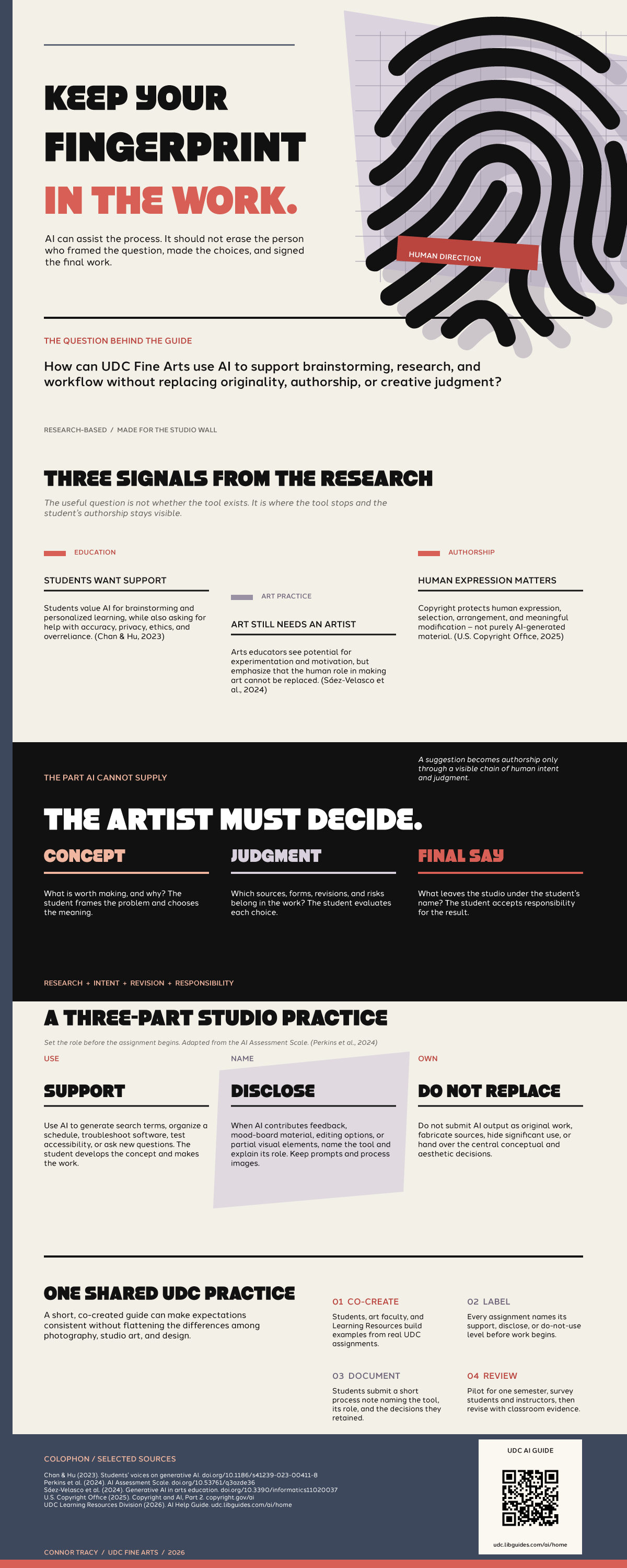
Keep Your Fingerprint in the Work
The infographic was my chance to turn the research into something that could be useful in an art classroom rather than another paper. It separates assistance from substitution and keeps the focus on intention, authorship, documentation, and revision.
Reflection
What I am taking from the course
The most useful part of this course was seeing how the same idea changed depending on the form. The memo had to be direct, the proposal had to be realistic, the annotated bibliography forced me to evaluate the sources, and the infographic made me reduce the research to what someone could use quickly. I had written research papers before, but this sequence made the process feel more connected.
The hardest part was keeping the topic focused. AI in art touches copyright, ethics, labor, teaching, and creative identity, and I often had more material than I could use. I still need to get better at cutting information earlier and giving myself more distance before revising. As I move toward graduate school and teaching art, I can see myself using this same process to plan courses, make proposals, and explain complicated ideas to students.
About
I am a photographer and senior Fine Art student at UDC. After more than a decade working professionally, I returned to school because I want to teach art and keep learning. I plan to pursue an MA or MFA after graduation.